

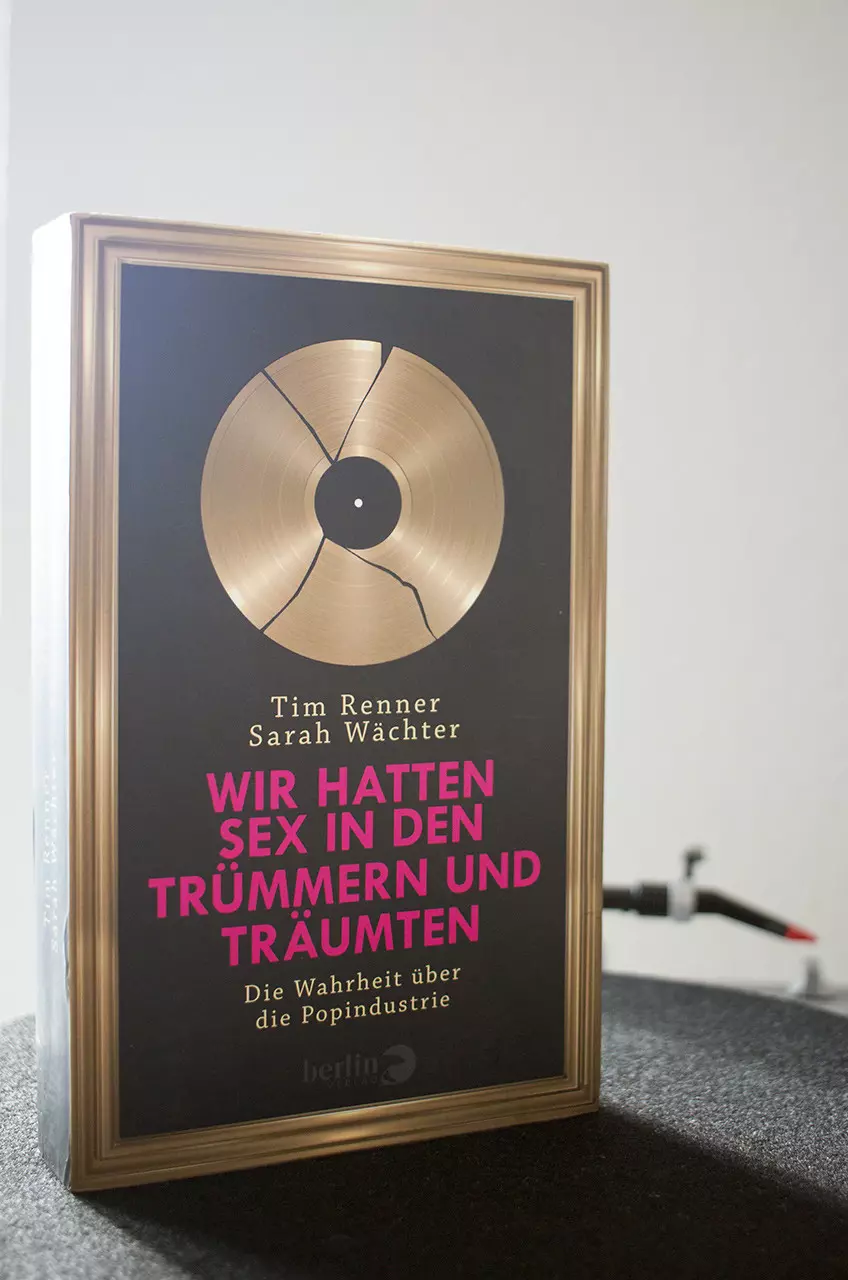

With this book title you’d only guess it’s about the music industry if you know the name Tim Renner (or the song Trrrmmer by Die Sterne). Together with Sarah Wächter, he has put together a stocktake of this industry. Throughout the book, the two share anecdotes about individual musicians and situations. In excerpts, the book compresses music history from the 1990s to the present day into 336 pages.
Tim Renner caught my attention at some point with some clever and controversial statements on copyright, and I was impressed, among other things, because he made these statements as an employee of a music publisher. If you bite the hand that feeds you, you’d better have balls – or know what you’re talking about. That was my quick conclusion.
Renner served as State Secretary for Cultural Affairs in Berlin until the end of 2016, wasn’t always met with approval there, and still likes to comment on the truly farcical music industry, as he does in “Wir hatten Sex in den Trümmern und träumten”.
One of the reasons I’m so enthusiastic about the book is that the topics and arguments are entirely in line with my own thinking. The music industry doesn’t just have an outdated system that exploits artists (unless you’re a few sizes bigger) and customers alike. It also keeps missing the boat when it comes to properly marketing its product!
In the previous sentence alone, with all the discussions about music, you can let the two words “product” and “marketing” melt on your tongue.
A Gorny is forever preaching that artists are being robbed and that you can’t just make their work freely available – where “freely” refers solely to alleged copyright infringements. All the other “the internet is rubbish because everything gets nicked” preachers follow suit, and recently Spotify, for example, has been dragged through the mud because artists are supposedly being exploited there. And nobody questions this!
There’s a calculation by occasional radio presenter Jan Böhmermann (I’m afraid I can’t find the interview again), in which he compares the figures: an artist receives roughly 30 euros for a single play of one of their songs on a radio station! If a comparable number of listeners (it was around 1.6 or 1.8 million) were to stream the same song, that would come to just over 3,000 euros.
This example is one of many, and both the pro-internet camp and the Gornys of this world have an astonishing number of them. The overlap between both positions is probably closest to reality, and part of that overlap is, for me, in this book.
But it’s not just about marketing and the merits or absurdities of the industry – it’s also about the stories of how artists became who they are now, and regardless of where you stand, you can have a proper laugh about these stories.
The book is available at the bookseller of your choice, but only in German.
This post is part of my reading page.


Leave a Reply